If your house is on fire...
You would probably get out of the place as soon as possible. That's pretty obvious, right?
Unfortunately, it's not so obvious when working on a software project, especially when the stakes are high and you have multiple stakeholders waiting for your team's solution. Most people would sacrifice their personal time and try to push the project forward by working harder and covering as many topics as possible in parallel to finish on time.
When we see a fire, we put on our firefighter hat and focus on putting out the flames. There's nothing wrong with this approach when it happens occasionally. The problem arises when it becomes a habit.
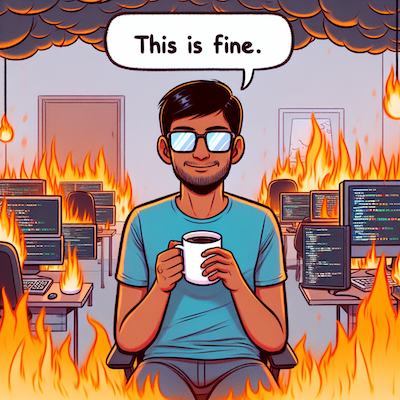
More often than not, we end up working in an environment where there is no innovation, no long-term solutions, and no time for learning.
So what can we do? Let's have a look at:
- The ideas from Elastic Leadership,
- The different team modes and,
- The approaches we need to take depending on the team's situation.
Enter... Elastic Leadership
I recently learned about this concept during a Tech Leadership training by Eduards Sizovs. Elastic leadership, as explained by Roy Osherove in his Elastic Leadership Book, emphasizes the importance of adapting leadership styles to the needs of the team and situation.
In his perspective, the role of the team leader is to grow the team into a self-organizing one.

Team Modes
In Elastic Leadership there are 3 modes in a team:
- Survival Mode: You know you're in survival mode when there's no time to learn. A one or two-hour meeting dedicated to individual learning doesn't count. It means really applying what we learn as a team to make lasting changes. It involves being able to make mistakes and learning from them. In survival mode, the team is too busy fixing issues or trying to bring the project to life.
- Learning Mode: Once out of survival mode, a team enters learning mode. This involves using around 60% of the team's capacity for learning activities. The focus is on what really matters and on training skills one by one.
- Self-Organizing Mode: The promised land. The team can fix most of the problems themselves and only needs a goal to work on.
Each mode has a different style of leadership:
- Command and Control: Dictator/Protector. Tell the team what needs to be done, establish rules on how to do it, and monitor the results. The goal is to free up as much time as possible for the team to learn.
- Coach: Still guiding the team on what needs to be done and how to do it, but with enough time to observe the team's growth. Establish a learning process.
- Facilitator: Encourage self-organization within the team. Provide goals, not actions.
Conclusion
I hope I was able to provide a brief overview of what elastic leadership is. If you think you're in survival mode, why not give it a try? In the future, I'll explain more about what needs to be done to get out of survival mode.